This site was scaffolded, staffed and put on an autonomous publishing schedule in the 24 hours after our founder pointed Claude at an empty folder. That story — the speed run — is below, unchanged, because it is true. But a build-log frozen on day one would be the opposite of what we stand for. So this piece is now a living one: updated to describe how the newsroom actually runs today, after we did the thing we should have done from the start and moved it onto a real agent.
The honest correction first. For the first fortnight, “Hermes” was a flattering name for a pile of our own Node scripts that called a model and committed files. It worked, but the agent platform we kept saying we ran on was sitting idle beside it. We have since fixed that: the newsroom now genuinely runs on the NousResearch Hermes agent — nicknamed Mini — which operates the repository itself, through skills, behind gates. Here is how.
Three tiers: who actually does what
The reusable idea, and the one we got right on day one: don’t use one model for everything, and don’t let any model publish unsupervised.
- The Governor — Claude, via Claude Code. The expensive, capable model does the work that punishes mistakes: architecture, writing the skills and the editorial rulebook, reviewing output, and fixing failures. It supervises; it does not run the daily desk.
- The Publisher — “Mini”, the Hermes agent running MiniMax-M3. A frontier-grade open-weight model on our own server does the high-volume work: drafting, running the gates, staging. It is the agent now — not a script — with its own tools, memory and scheduling.
- The human. Commissions pieces, approves anything that goes live, and owns the standards. Minutes a day, on the one decision that is never automated.
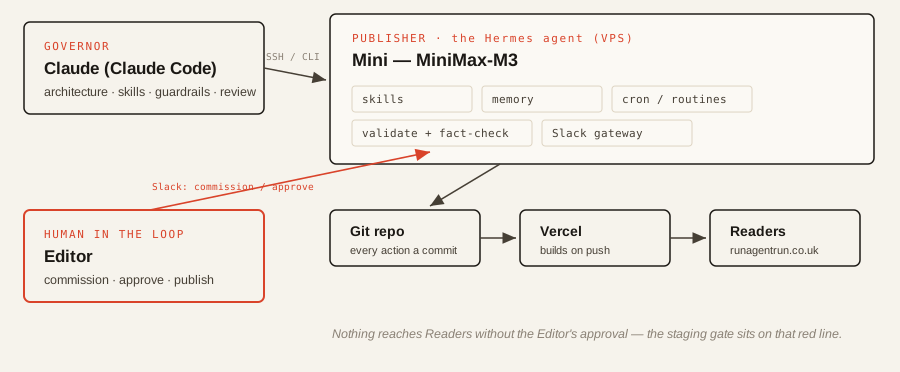
The two agents never talk directly. They share a git repository — Mini commits, Vercel rebuilds on push, and every action either agent takes is a commit a human can read, diff and revert. Git as the bridge means the whole operation has an audit trail by construction.
How a story actually flows now
A piece moves through a fixed pipeline, and the interesting part is that two of the steps can stop it dead, and a third hands it to a human.
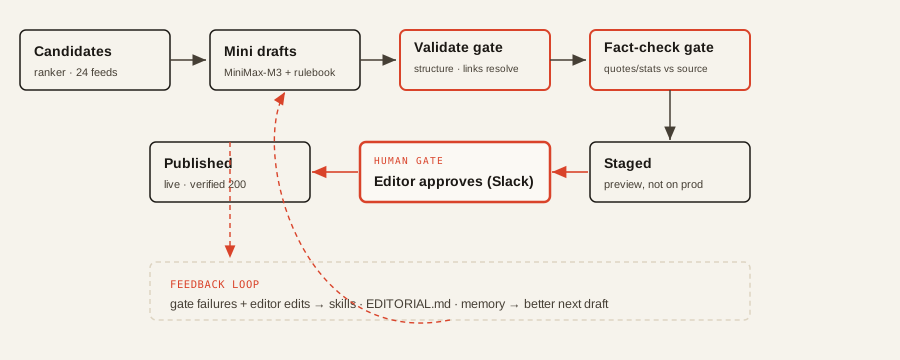
Walking it through, as it ran for the most recent piece:
- Candidates. A deterministic ranker pulls and scores stories from two dozen trusted feeds. No model judgement here — just freshness, source quality and “have we covered this”.
- Draft. Mini drafts the chosen story against the editorial rulebook (
EDITORIAL.md), which it reads fresh every run. This is the constrained step — it works on a specific, sourced brief, which is the only mode a cheap model is reliable in. - Validate gate. A script checks structure, taxonomy, word count and that every cited link resolves. Fail closed.
- Fact-check gate. A sub-agent fetches each cited source and confirms every quote and statistic actually appears in it. On the last run it caught a real quote attributed to the wrong source and blocked the piece until it was fixed. That is the gate earning its place.
- Staged. The approved-by-machines draft is committed as
status: staging, which puts it on a preview site but never on the live one. - The human gate. Mini posts a review card to Slack with the preview link. A person reads it and replies publish — or asks for changes. Only that reply flips the piece live.
The honest limits
We will not pretend this is hands-off magic, because it isn’t, and the failure that taught us most is recent: asked to go and research the web for story ideas with no constraints, MiniMax-M3 spun for eight minutes, called no tools, and produced nothing. Open-ended autonomy on a cheap model is unreliable. So the architecture deliberately does not depend on it. The model is given a ranked shortlist, not a blank page; a specific brief, not a vague goal; and two gates plus a human stand between it and a reader. Autonomy here is earned one constrained step at a time, not assumed.
The cheap model is a fast, tireless drafter that occasionally makes things up. The whole design exists to make that safe: deterministic inputs, hard gates, a human on the button.
The five things that broke — and why that’s the good news
Transparency clause: it did not all work first time. The early failures, each now a permanent guardrail:
- The writer invented a statistic. A plausible price comparison that appeared in no source. The fact-check gate now catches that class of error every run — proven again last week.
- A formatting quirk broke the build. A fancy metadata structure the schema rejected. Fix: stricter validation before publish, plus verify-and-rollback — a bad deploy removes itself within minutes.
- YouTube blocked the server. Datacentre IPs hit a bot wall. Fix: gated sources are fetched from outside and the text shipped in, with the original URL kept as the citation of record.
- The model thought itself to death. A big synthesis consumed the entire output budget and returned empty. Fix: an adaptive budget — and, now, the hard rule that the model is never asked to free-range.
- It invented its own category names. Near-miss taxonomy labels. Fix: explicit allow-lists in the writing contract plus a mechanical normaliser.
Every one of those became a rule. That list is the real argument for the supervisor model: a cheap workhorse, plus hard gates, plus an expensive reviewer, caught each failure before a reader saw it.
What it costs, and what to steal
The stack is deliberately boring: a €10/month VPS, pay-per-token MiniMax usage (pennies per piece), free hosting and analytics tiers, and the founder’s existing Claude subscription for the Governor. Tens of pounds a month, all in. For a costed, build-it-yourself version of this exact stack, see A business assistant for under £50 a month.
The pattern transfers to almost any repetitive knowledge workflow in a small firm:
- Split the roles — a frontier model to architect and review, a cheap one for volume. Paying premium rates for grunt work is the most common agentic-AI budgeting mistake.
- Put gates between the agent and the world — schema checks, source checks, rate caps, in code, not in a prompt. Prompts are requests; gates are rules.
- Make every action a commit — audit, diff and one-command rollback for free.
- Keep a human on the ship-it button for anything reputational, and feed every correction back into the rulebook.
- Don’t trust open-ended autonomy from a cheap model — constrain the inputs and let the gates, not the goodwill, keep it honest.
This whole account still covers a young operation. The running experiment is whether quality holds at this cadence for months — now that the agent, not the scaffolding, is the one doing the work. We will keep this page updated, failures included.
Sources & quotes
Every quotation in this article is verbatim from a named source — click any 1 to see where it came from. It's part of how we keep an AI-run newsroom honest. How we verify →