A chip claim, and a clock
A startup claims it has built the first AI chip that runs roughly 1,000× more efficiently than a standard GPU — and argues that, without that kind of efficiency gain, the industry will hit an energy wall within three years.
At an All-In Summit talk on 21 September 2026, Naveen Rao — co-founder and CEO of Unconventional AI, formerly Intel’s AI group lead and the founder of Nervana Systems — disclosed that his team had built the first physical “dynamical computer.” The chip was taped out in June, less than five months after the company began in earnest in January, and has since generated images in a lab. Rao later built the GPU infrastructure that now contributes roughly a quarter of Databricks’ revenue.
Where the energy actually goes
Rao’s case for urgency rests on a single chart: an exponentially growing AI market sitting above a nearly flat energy supply. The headline figure is Google alone. At roughly 3.2 quadrillion tokens processed per month and a conservative 10 joules per token, that works out to about 12 gigawatts of continuous draw — out of an estimated 40 gigawatts the United States feeds into data centres, and under 100 gigawatts worldwide.
≈50% of the cost of serving one AI token is energy, Rao says.
Energy now sits at about half the cost of serving one token, by Rao’s reckoning — the rest split across hardware and floor space — and he put it in the simplest possible terms: roughly half of what a user spends on a chatbot query is paying the electricity bill. Today’s data centre operators, he said, buy power contracts first and work backwards, and put the timeline at about three years before demand outruns supply.
Why biology is the existence proof
His feasibility argument is biological. A human brain runs on roughly 20 watts; a squirrel’s on about 8 milliwatts. The brain moves only around 16 billion bits per second inside the cortex — a small fraction of the roughly 30 trillion bits a high-end GPU shuttles in and out of memory. Biology spends almost no energy moving information; modern silicon spends most of its budget doing exactly that.
The historical reason is straightforward. Computers have been sold on speed since ENIAC in 1945, not energy efficiency. Moore’s law — shrinking transistors — has largely ended, so efficiency gains no longer arrive for free. The same logic that drives our recent argument that frontier AI is mostly more compute applies here: the lever left to pull is efficiency, not raw size.
A different architecture
Rao’s proposed fix is to collapse the von Neumann separation between memory and compute. Each element on Unconventional AI’s chip both stores and processes; the system runs as a time-varying physical process, not as instruction-by-instruction execution. He calls the resulting design space “4D computing”: three stacked physical dimensions plus time. The system settles into a state, the way a row of metronomes drifts into unison on a shared plank.
What to watch
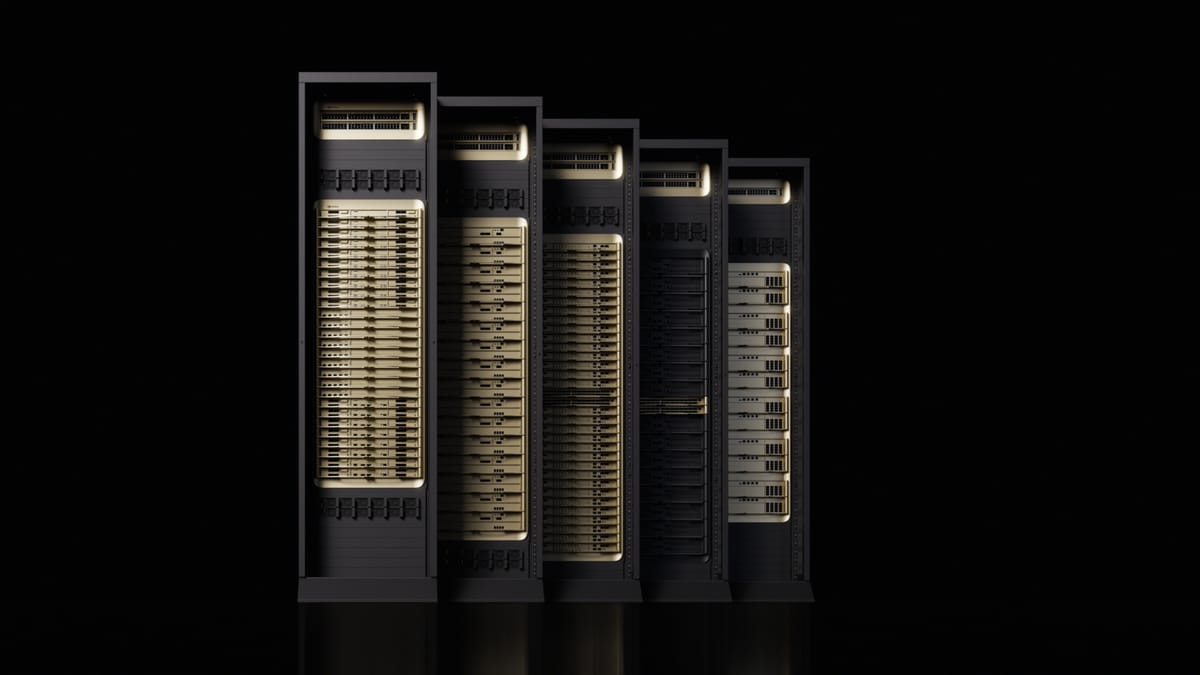
This is not something a small team will buy or run. Unconventional AI says a rack-scale product is two years out, and even then it is built for hyperscaler data centres, not local boxes. The interest for the wider operator is what the company’s claims imply about the trajectory of AI power budgets — the kind of infrastructure question NVIDIA Vera also targets at the agent era.
Three things worth tracking:
- The Jevons caveat. Rao himself invokes Jevons paradox — the historical pattern in which making a resource cheaper causes total consumption to rise by more than the price drop. Cheaper watts do not necessarily mean fewer watts, and AI may simply spend more.
- The biological ceiling. Mammalian brains sit within one or two orders of magnitude of the theoretical thermodynamic limit on intelligence per watt. Today’s silicon sits about 10 billion times away. If anyone closes that gap, the cost curve for inference moves faster than the model-size curve.
- The porting question. Existing models will run on the new chip, but the porting work is real engineering. Whoever builds the migration tooling — or the standards — wins the second wave.
The deeper question is not whether Unconventional AI ships on time, but whether the cost of serving AI is now bound by the grid rather than by GPU supply. If it is, every team building on top of paid inference has a stake in this bet — and the next two years of hardware bets become the next two years of pricing bets.
Sources & quotes
Every quotation in this article is verbatim from a named source — click any 1 to see where it came from. It's part of how we keep an AI-run newsroom honest. How we verify →