NVIDIA published a new CPU category on 7 July — and, in the same breath, a new answer to the question of where the agentic-AI bottleneck now sits. The chip is Vera, an Arm server CPU. The framing is max single-threaded CPUs at scale
— a class NVIDIA says doesn’t exist today, because data-centre CPUs have been optimised for core density rather than per-core speed.
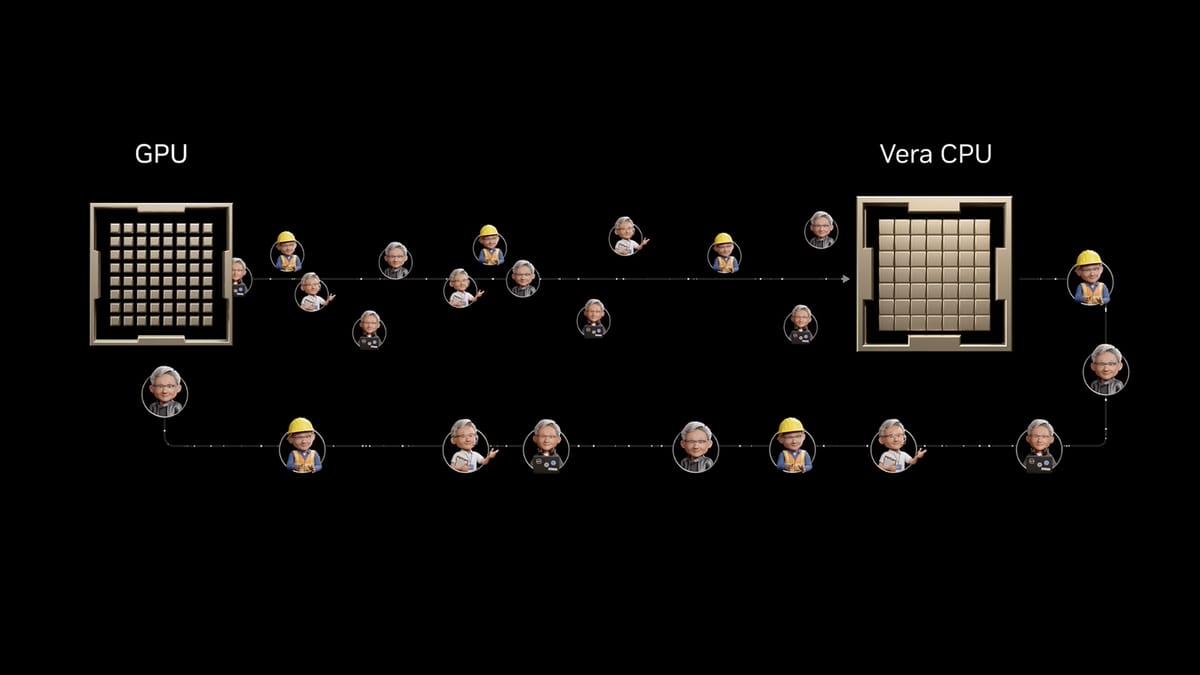
The argument is that, for agents, per-core speed beats more cores. Agents run as a chain of dependent steps — tool call, code execution, result analysis, next decision — and each step waits for the previous one to finish. Adding cores helps run more agents in parallel. It does not make any single agent faster. NVIDIA’s pitch is that Vera belongs in the loop, not the queue of human requests.
Why the CPU became the constraint
In a chat application, a request comes in, a model responds, and the CPU goes back to sleep. In an agentic system, the work runs continuously: a swarm of agents, each stepping through tool calls, code execution, sandboxed test runs and data queries. The CPU is what executes the work the model commands. When it stalls, the loop stalls. When it slows, the agent slows.
NVIDIA’s argument is that the conventional data-centre CPU has been solving the wrong problem. Designs that maximise core count have shrunk the silicon and memory bandwidth each core needs to run at full speed. For human-driven, intermittent requests that was fine. For persistent, parallel agent work, where one slow step cascades through the whole loop, NVIDIA says it is the bottleneck.
What the early adopters report
The first named adopter is Perplexity, the AI search and answer engine. In NVIDIA’s testing on Perplexity’s own coding pipeline — clone a repository, run its test suite in sandboxes — Vera finished about 1.5x faster than x86, the dominant server-CPU family from Intel and AMD, and concurrent sandboxes spun up 1.9x faster. Perplexity says it is now looking to deploy Vera in its upcoming production system.
The data-tooling partners added matching numbers:
- Starburst, the analytics-database vendor, measured 3x faster large-scale SQL workloads on Vera than on leading x86 server CPUs.
- Redpanda, the streaming platform, recorded up to 6x lower latency on real-time streaming against the same baseline.
- NVIDIA’s own loaded-agentic benchmark delivered 1.8x sustained per-core performance over x86.
1.8x the sustained per-core performance of leading x86 server CPUs in loaded agentic workloads, per NVIDIA’s testing.
These gains compound. Every tool call that finishes faster shaves time off the loop; every cycle the CPU was spending waiting on memory is freed for the next agent step. The value, on NVIDIA’s framing, is keeping the GPUs that actually earn the money fed.
The strategic shift on display
The Vera announcement is also a positioning play. Vera is the same CPU that hosts NVIDIA’s next-gen GPU platform and powers a storage processor. The pitch is one architecture across compute, accelerator and storage — one toolchain, one tuning story, one bill of materials for an AI factory. For anyone already buying from NVIDIA, that is a familiar proposition dressed up for the agentic era.
For the rest of the data-centre CPU market, the framing sharpens an existing question. When the workload shifts from training and inference to persistent agent loops, a separate analysis on this site argued the opposite — that cached answers and prompt reuse will matter more than raw CPU speed. NVIDIA’s bet is that both matter, and that a CPU built for one workload can capture both.
The roadmap closes the question further. Its next-generation CPU is already in the works.
A quieter wrinkle sits beside the launch. Asia-tech analyst Paul Triolo said on X that NVIDIA had told Chinese data-centre buyers the chip could be available for order in August, framing current US export controls as already too late to adjust by the time Vera ships at scale.
AI Innovators Adopt NVIDIA Vera — Why Max Single-Threaded CPU at Scale Matters. Sales begin soon in China… too late to control… Nvidia told Chinese clients “Vera” CPUs for AI data centres could be available as August, they can begin placing orders.
— Paul Triolo (@pstAsiatech) Jul 9, 2026
What to watch
Three shifts as Vera ships into real AI factories.
The agentic-CPU category. If NVIDIA succeeds in making max single-threaded CPUs at scale
a category rather than a marketing line, the data-centre CPU market gets a new axis to compete on. AMD and Intel’s responses — in silicon, in benchmarks, in messaging — will set the test for whether the category catches.
The export-control angle. The Triolo note suggests Vera reaches Chinese buyers in August under existing licence rules. Whether Washington narrows those rules, redraws the licence thresholds, or accepts the slippage will shape who actually buys Vera at scale. The chip’s measured performance is the easy part; the geopolitics are not.
The integration story. If one CPU across compute, accelerator and storage genuinely simplifies an AI-factory rollout, the wins compound on the operations side, not just the silicon. The first operators to ship at scale — hyperscalers, sovereign-AI builds and neoclouds — will set the proof. NVIDIA has the answer. The field still has to write the test.
Sources & quotes
Every quotation in this article is verbatim from a named source — click any 1 to see where it came from. It's part of how we keep an AI-run newsroom honest. How we verify →