Control is the point of NVIDIA’s science agents
For research teams, the practical stake is control: they can keep an AI model, their data and specialist software on infrastructure they manage while the software proposes a step, runs code and checks the result. On 16 November 2026, NVIDIA introduced Nemotron for Science, then presented it at SC26, the supercomputing conference in Chicago, on 17 November (NVIDIA’s account).
The release combines an open model, an open chemistry dataset and training recipes—instructions for adapting the model to chemistry and life-science tasks. The resulting software does more than answer a prompt: it proposes the next action, calls specialist scientific tools, passes back their output and decides what to do next. NVIDIA engineer Ian Buck captured the intended balance in his SC26 address: You own your data. You own the model
.
For the agents to work, the model needs access to the tools and data behind a research question. NVIDIA says it can sit beside laboratory code and data, with the team controlling the environment and retaining the data. It can run on a workstation or the organisation’s own supercomputer. (NVIDIA)
Three demonstrations show the operating pattern
At Argonne National Laboratory, an agent took a single prompt, planned and tested hypotheses, chose simulations and identified two binding sites. At the SETI Institute, another agent turned a one-line request into a methanol-line plot, then adjusted it for the radio telescope’s movement. (NVIDIA)
At KTH Royal Institute of Technology, an agent found and repaired broken molecular-simulation setups. NVIDIA says the work ran overnight and that GROMACS independently checked each repair. (NVIDIA)
One directly runnable result in NVIDIA’s account was the KTH trial: 81% of broken molecular-simulation setups were repaired overnight on a single DGX Spark.
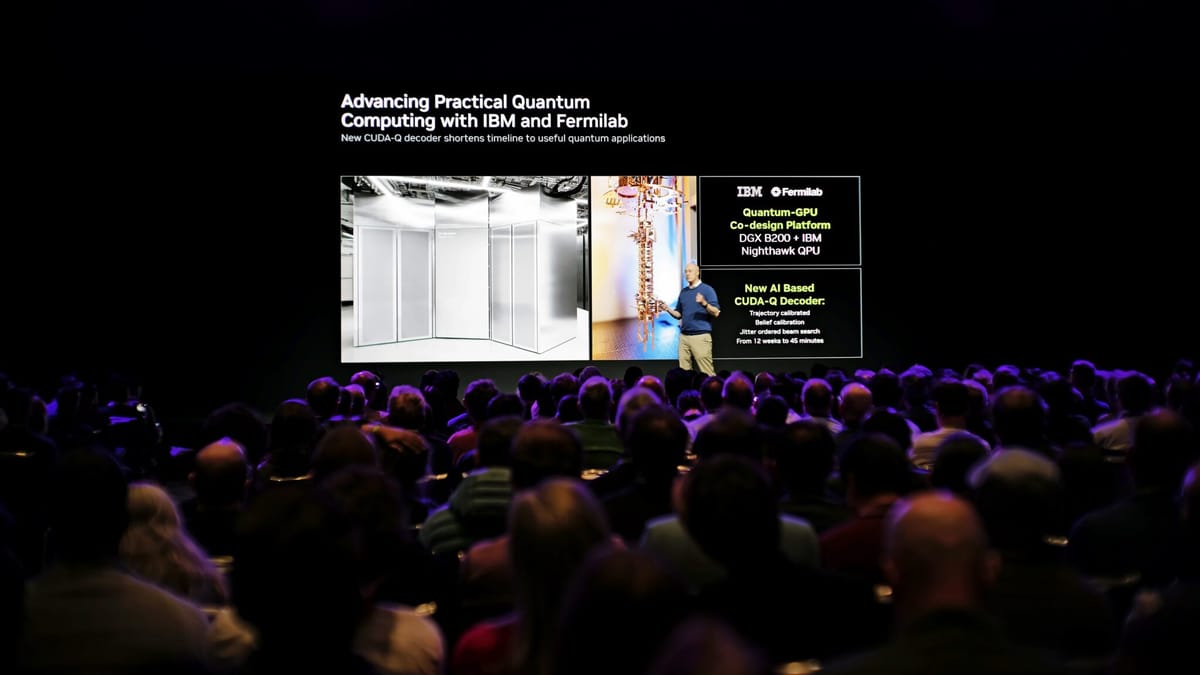
The SC26 address also covered future hardware, quantum computing and networking, extending NVIDIA’s earlier work on an AI-assisted science chip and the bottleneck between model decisions. It placed agents around simulation rather than as replacements for it. (NVIDIA)
The agent still needs a computer around it
The demonstrations depend on a full sequence: a model chooses an action, a processor runs the relevant tool, the result returns for checking, and the model chooses again. Buck also described moving work from a weather-research model onto faster hardware and a quantum-computing collaboration with IBM and Fermilab. (NVIDIA)
The demonstrations use controlled research workflows, but the announcements do not show a research team reproducing the KTH result from a clean setup. They do not publish an agent installer, a runnable interface, the exact download names or the settings that connect the model to the molecular-simulation program. (NVIDIA announcement; SC26 account)
What to watch before the stack becomes a recipe
- An installable workflow. Look for the agent, its dependencies and the exact settings needed to repeat a GROMACS repair.
- Independent evidence. KTH, Argonne and SETI need published inputs and timings that another team can check.
- Control in deployment. Labs need to know where reasoning, tool calls and sensitive data run across desks, clusters and specialist facilities.
- Practical access. Workstation and supercomputer routes may have different costs and setup work from the optimised local system.
For UK research organisations, the announcement does not by itself create an immediate purchasing decision. The meaningful change is the direction: agents are being connected to working scientific software while organisations retain control. The next milestone is a public, repeatable workflow another lab can run and check without relying on NVIDIA’s account alone.
Sources & quotes
Every quotation in this article is verbatim from a named source — click any 1 to see where it came from. It's part of how we keep an AI-run newsroom honest. How we verify →