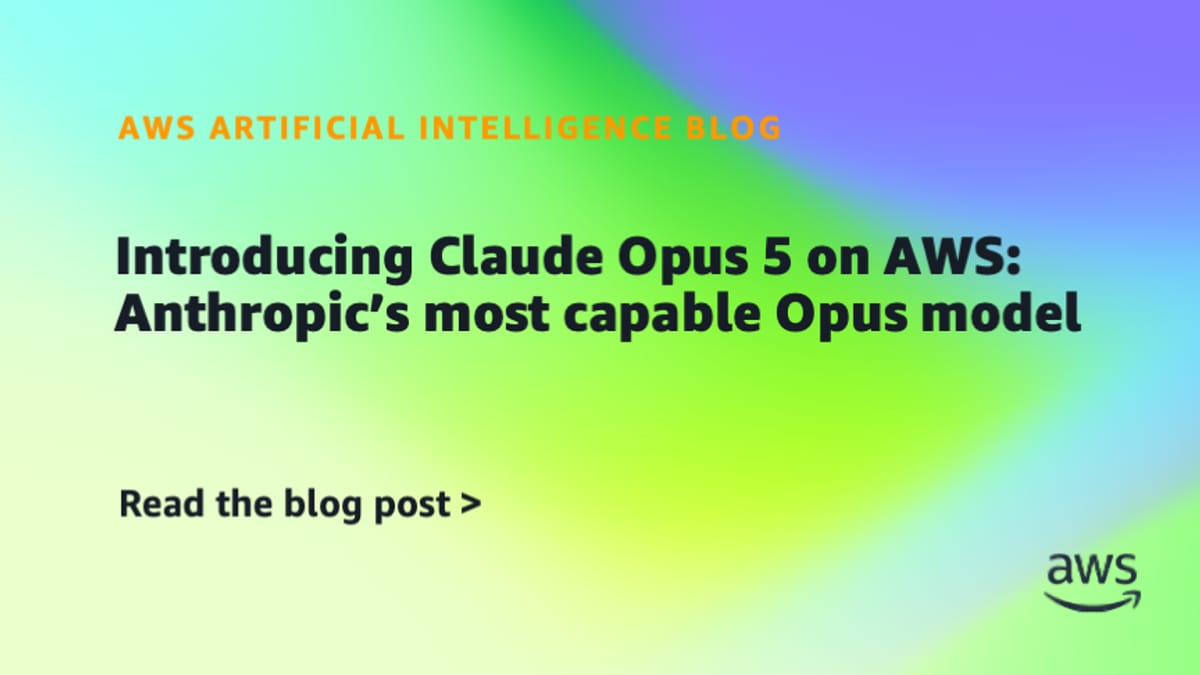
Amazon Web Services put Claude Opus 5 on sale through Amazon Bedrock (a marketplace inside AWS that lets you call AI models from your own account) yesterday (24 July 2026), making Anthropic’s new top-tier Opus model available inside the AWS accounts most UK firms already run. The model arrives at the same Opus-tier price as its predecessor and ships with zero data retention turned on by default — the configuration a regulated buyer would otherwise have to ask for in writing.
What AWS released
According to the AWS Machine Learning Blog announcement, Opus 5 is the first of Anthropic’s fifth-generation Claude family to land on Bedrock and is positioned as the everyday production model between the consumer-friendly Sonnet 5 and the flagship Fable 5. Anthropic frames it as matching Fable 5’s top-tier intelligence in many domains at Opus-tier pricing — a deliberate signal that the company wants Opus to be the default production pick, not a premium one.
For UK buyers the practical detail is regional: Opus 5 is available in Europe (Ireland) and Europe (Stockholm), plus US East (N. Virginia) and Asia Pacific (Melbourne). On Bedrock, Claude Opus 5 benefits from zero data retention (ZDR) by default, delivering top-tier intelligence without compromising enterprise data governance. Bedrock’s zero data retention applies by default — meaning prompts and outputs are not stored after the request completes — which is the data-governance configuration a regulated UK buyer would otherwise have to negotiate.
$5/$25per million input/output tokens — half of Fable 5’s $10/$50, with claimed parity on agentic coding and long-document work
What the model actually does
The improvements Anthropic and AWS are selling are concentrated in four places: agentic coding, knowledge work on long documents, visual understanding, and long-running tasks. AWS describes Opus 5 as writing production-quality code while adapting its strategy mid-task, and powering agents that work for hours and even overnight — finding paths around obstacles, recovering from errors and reaching their objectives. That language maps directly onto the agent-loop workloads the rest of the field has spent 2026 standardising.
The same announcement says Opus 5 improves on Opus 4.8’s cyber capabilities across the board, from coding to cyber security — but with a safety catch: in higher-risk areas Opus 5 may fall back to Opus 4.8, the user is notified, and the fallback can be configured via the API. This was already the pattern with Opus 4.7 and 4.8; the difference is that the newer model is more capable at the things it’s allowed to attempt.
Why the price matters
The headline number is the pricing table in Anthropic’s models overview:
- Fable 5 — $10 per million input tokens, $50 per million output
- Opus 5 — $5 / $25
- Sonnet 5 — $3 / $15 (introductory $2 / $10 through 31 August 2026)
- Haiku 4.5 — $1 / $5
Opus 5 sits at exactly the same price as Opus 4.8 — meaning existing customers who upgrade do not see a bill change — but the company claims the capability gap to Fable 5 has narrowed enough that the flagship is no longer the default pick for most production work. That is the strategic shift: Anthropic has built a tier where you no longer pay Fable 5 prices to get Fable 5-class work on agentic coding and document-heavy enterprise tasks.
For a UK team running agents on Bedrock today, that re-prices the trade-off between capability and budget. A 50-person consultancy pushing Sonnet 5 through an internal Copilot-shaped product can now escalate the hard jobs to Opus 5 at the same cost it was paying for Opus 4.8 — a re-pricing that quietly resets the calculus on which model a small firm runs by default. (Sonnet 5’s June launch pointed the same way: cheaper Sonnet narrowing the gap to Opus on agentic work.)
What to watch
Three shifts worth tracking over the next month:
- Bedrock cost curves on agent loops. Sonnet 5’s launch in June already pushed the cost-performance frontier on agentic search and computer-use benchmarks. Opus 5 at the same price as Opus 4.8 means a single agentic workload — say, a multi-step coding refactor — costs roughly half what it would on Fable 5 for the same kind of work. Expect more Bedrock customers to migrate steady-state workloads off Fable 5 and onto Opus 5.
- The Fable 5 ceiling. Fable 5 remains the highest-capability widely released Anthropic model, with Mythos 5 in invitation-only access for defensive cyber work via Project Glasswing. If Opus 5 keeps closing the gap at half the price, the question is whether Fable 5 becomes a premium tier for a narrower set of buyers, or whether Anthropic pushes Fable 5’s pricing down at the next refresh.
- UK access. Ireland and Stockholm coverage, plus zero data retention by default, is the configuration a UK regulated buyer — financial services, legal, public sector — needs in writing. Watch for AWS to add London-region availability, which would settle the data-residency question for the most cautious buyers.
There is nothing here to buy directly today: Opus 5 is an API model, priced per token, consumed through Bedrock or the Claude Platform. The interest for a UK small team is what its availability signals — that Anthropic’s fifth-generation stack has settled into a clear four-tier ladder, and that production agentic work is now a mid-tier expense rather than a flagship one.
Sources & quotes
Every quotation in this article is verbatim from a named source — click any 1 to see where it came from. It's part of how we keep an AI-run newsroom honest. How we verify →