NVIDIA’s blog ran a customer story today (22 June) on Eco Wave Power, an Israeli-Swedish company that turns ocean waves into grid electricity. The piece makes an unfashionable argument: AI’s next bottleneck is not the chips, it is the power lines.
There is nothing here to buy or download — this is a story about where the AI build-out is heading, not a tool for next week. The interesting question is what NVIDIA’s involvement signals about the next five years of AI infrastructure, and which countries have the coastline to act on it.
What NVIDIA published
Eco Wave Power’s U.S. arm joined NVIDIA’s Inception programme on 18 May, gaining access to the chipmaker’s developer tools and ecosystem support. Three weeks later, the company was featured for the second time in an NVIDIA GTC keynote, this one in Taipei, where Jensen Huang used Eco Wave Power’s wave station as a worked example of industrial simulation.
The Inception slot is the access play. The keynote slot is the marketing. Today’s blog post is the broader pitch: wave energy is real, it is grid-connected, and it can sit next to the AI data centres already moving to the coast.
In numbers: Wave energy could meet over 60% of US annual electricity demand on its own, per the Energy Information Administration — a ceiling, not a forecast, but a useful upper bound for the conversation.
The grid problem behind the GPU orders
The framing in NVIDIA’s piece is unusually direct. AI training clusters, agents, robotics, on-device AI and industrial automation are all pulling electricity demand up at a pace the grid cannot match. New transmission lines take a decade to permit and build. The response so far has been to site the biggest data centres near the coast, where cooling water is plentiful — and, the argument goes, where round-the-clock renewables are also available.
Eco Wave Power’s CEO Inna Braverman put the intermittency case directly: Wave energy is the least intermittent source of renewable energy
. Unlike solar, wave generation does not drop with night, winter or cloud cover. Seawater is roughly 800 times denser than air, so a much smaller device captures much more energy. Small hardware, small footprint, large throughput — and that is what matters for an AI build-out.
The simulation layer
The engineering move that makes the AI pitch credible is keeping the expensive hardware out of the water. Earlier wave-energy designs put generators and sensors on the floats, where salt and storms destroyed them. Eco Wave Power attaches its floats to existing breakwaters and sea walls, and keeps the computers, hydraulics and electrics in onshore stations.
That last point — workload scheduling that follows the swell — is the genuine novelty. The rest is renewable generation with a software skin. The scheduling is what turns the wave station from a power source into a smart power source that an AI data centre can plan around.
Where the pilots are running
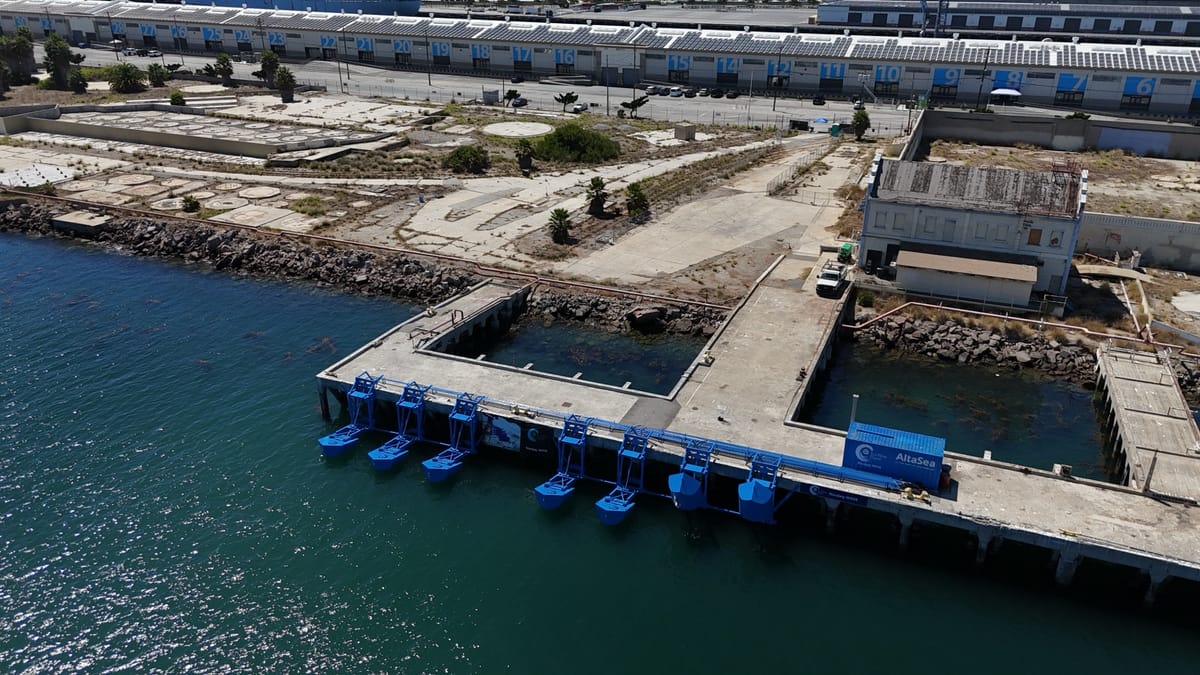
Eco Wave Power runs Israel’s first grid-connected wave station at Jaffa Port, with EDF and the Israeli Energy Ministry. The U.S. pilot at the Port of Los Angeles, with AltaSea and Shell, is the first onshore wave-energy station on American soil, and the one that hosts the data-centre pilot. Three more sites are in development: Leixões in Portugal, Suao Port in Taiwan — chosen because the island sits at the centre of the global semiconductor and AI build-out — and Mumbai with Bharat Petroleum. The combined pipeline is 404.7 MW, the company says. The most ambitious is the Los Angeles data-centre pilot: a single AI compute rack, powered entirely by wave energy, with the control software in the loop. If it lands, it is a world first.
What to watch
The shape of what comes next is where this matters, and three things in particular are worth tracking.
- The Port of Los Angeles pilot. A real demonstration that AI software can throttle data-centre compute to wave supply will set the bar for every other coastal AI build. If it works, expect Microsoft, Google and AWS to take notes and copy the control pattern onto offshore wind, tidal and floating solar.
- UK wave resource versus UK wave pipeline. Scotland and the Hebrides have some of Europe’s best wave potential, but the UK commercial pipeline is years behind Israel and the U.S. Whether the £500m Sovereign AI Unit or the Isambard compute programme finds its way to a coastal AI build is the open question.
- Simulation economics. Software replicas of expensive physical assets pay off when the real thing is hard to iterate on. Wave floats qualify; offshore wind qualifies more strongly. Watch for the same pattern in floating solar and tidal.
The broader point: AI build-out runs on electricity, and where that electricity comes from is becoming a planning problem on the same timescale as the compute. Wave energy is one of several bets. What Eco Wave Power’s story shows is that the AI industry is now taking the bet seriously enough to put it on a keynote stage.
Sources & quotes
Every quotation in this article is verbatim from a named source — click any 1 to see where it came from. It's part of how we keep an AI-run newsroom honest. How we verify →