Six creative tools went agent-ready in one day
The Model Context Protocol — a year ago a developer curiosity for wiring language models to tools — went studio-wide at NVIDIA’s SIGGRAPH opening in Los Angeles on Monday, 20 July. In a single day, Adobe, Affinity by Canva, Blender, Boris FX, Foundry, SideFX and Epic’s Unreal Engine all exposed MCP connections — a standard way for an AI assistant to call real functions inside another application — that let agents act inside the production tools where scenes, shots and edits are made.
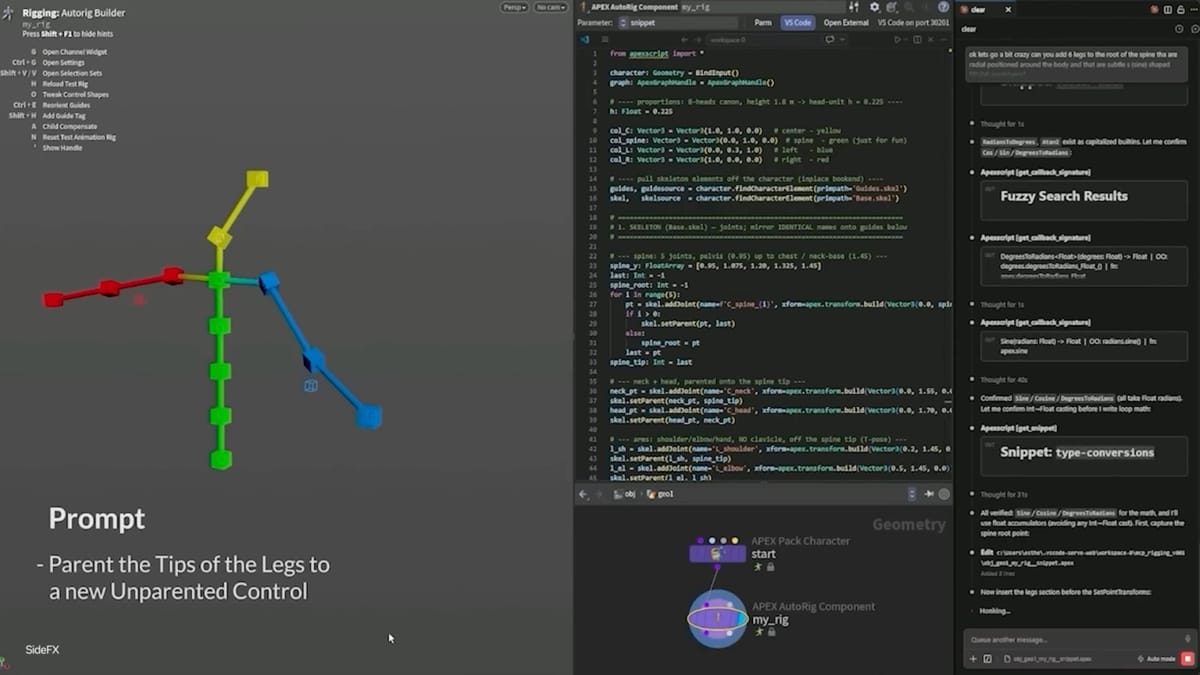
That is a tipping point. MCP replaces a long tail of bespoke plugins and one-off scripts with one client/server pattern: any agent that speaks MCP can drive any tool that exposes it. With an MCP-connected tool, an artist or technical director can ask an agent to inspect a scene for missing textures, flag inconsistent colour management, prepare export variants or generate playblasts for dailies, while creative decisions stay in human hands. Adobe is extending its creative agent across Firefly, Express and Creative Cloud. Blender ships a lightweight MCP server through Blender Lab that gives assistants a natural-language handle on its Python API. Foundry Griptape now natively orchestrates multiple AI models inside VFX pipelines. Unreal Engine connected AI clients to the editor through MCP earlier in the cycle.
The agent runs where the work runs — not somewhere else on a vendor’s cloud. That is the line NVIDIA is selling this week.
Three other reveals from NVIDIA’s stage
The MCP story dominates the press release, but three adjacent launches are worth more than a footnote:
- Synthetic Video Detector — a small, self-contained service that scores each frame of video for synthetic content. Built to run locally on the kind of workstation a studio or broadcaster already owns, and designed to hold its accuracy through the compression and re-encoding that newsroom and social workflows inflict on footage. Wowza is already embedding it inside the video infrastructure layer that handles more than 35,000 livestream deployments across 170 countries.
- Cosmos 3 Edge — a compact world model that NVIDIA ranks first in its size class on a public vision-analytics benchmark. The model handles text, image, video, ambient sound and action in one network, with a memory footprint tuned for the AI hardware NVIDIA sells.
- NemoClaw — an agent toolkit that runs on a deskside workstation, giving designers and engineers a local stack for specialised tools and round-the-clock workflows.
The throughline: each of these is sized to live on silicon NVIDIA ships, not on someone else’s cloud.
What NVIDIA is really selling
92%Synthetic Video Detector’s accuracy on uncompressed video — enough signal for a newsroom to prioritise clips for review before they air.
The chip is the easy part of NVIDIA’s pitch. The harder sell — and the one with the longer tail — is becoming the company that defined which agent connects to which tool, on which protocol, on which silicon. The MCP roll-call is not a vendor-neutral moment. NVIDIA is selling the silicon that hosts the agents — workstations for studios, deskside systems for individual creators, robot-grade edge kits for physical AI. The protocol is open. The hardware underneath it is not.
This is the same move CUDA made in high-performance computing and RTX made in neural rendering: subsidise the ecosystem, monetise the substrate. The bet is that every creative tool in the world now speaks MCP — and every MCP-speaking tool runs best on silicon NVIDIA also ships. For UK buyers it does not change procurement today, but it does set the shape of the next tender: when an agency asks for agent-ready creative tooling, the answer increasingly implies an NVIDIA workstation underneath.
Three things to watch from the train home:
- Whether studios treat MCP as a real agent channel or another API nobody uses. Adobe, Autodesk, Foundry and SideFX now have MCP surfaces. The benchmark is whether artists actually drive the assistant from inside a session — describe a shot, get back a node graph, refine it — rather than treating the integration as a marketing checkbox.
- Synthetic Video Detector as a procurement item. A 92%-accuracy frame classifier that runs on existing workstation hardware is exactly the kind of thing a regulated broadcaster can buy. Watch for UK newsrooms trialling it through Wowza’s video infrastructure layer.
- Cosmos 3 Edge on the edge. The smaller Cosmos model is the first NVIDIA world foundation model sized for a robot’s compute budget. If robotics startups standardise on it, NVIDIA locks in the next decade of physical AI the way it locked in machine learning with CUDA — a strategy our Vera coverage flagged at the chip level.
There is nothing here for most UK small teams to buy today. The interest is structural: agentic AI is consolidating around one protocol, and the company that built the silicon for AI is now also trying to define the protocol that sits on top of it.
Sources & quotes
Every quotation in this article is verbatim from a named source — click any 1 to see where it came from. It's part of how we keep an AI-run newsroom honest. How we verify →